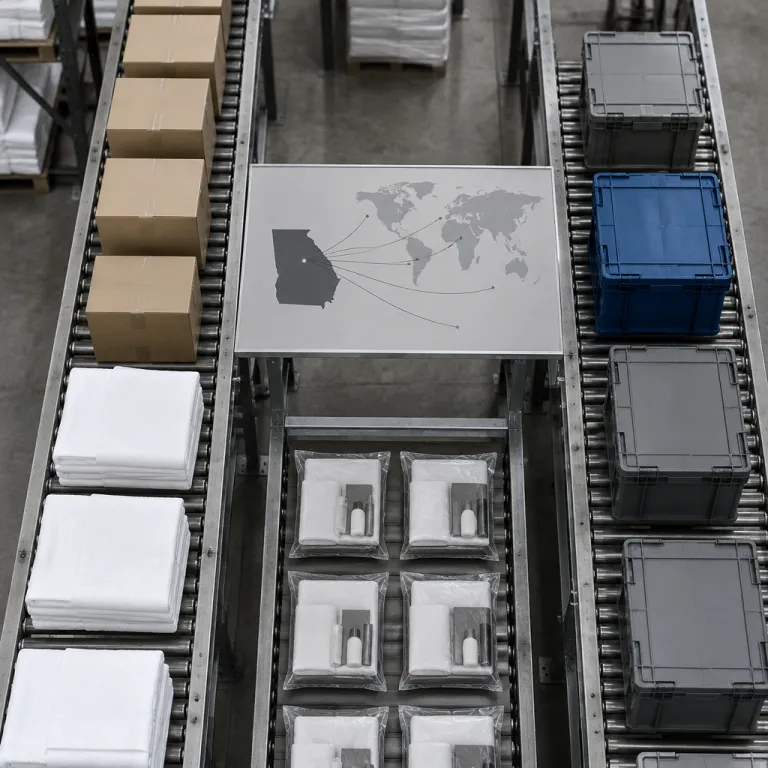
Why georgia 3PL strategy matters for B2B hotel distribution leaders
For B2B hotel distribution leaders, the phrase georgia 3PL usually evokes freight sheds, containers, and trucks rather than room nights. Yet third party logistics providers in Georgia increasingly shape how hotel groups negotiate allotments, manage group blocks, and serve corporate clients across North America. When your sales team promises a multinational account same day confirmations and rapid changes, the underlying logistics operations in Atlanta and Savannah quietly determine whether you keep that promise.
Georgia has become a strategic bridge between hospitality distribution and global supply chain solutions, thanks to its deepwater port infrastructure and dense network of logistics companies. The Port of Savannah and the wider georgia ports system connect hotel brands, wholesalers, and tour operators to worldwide flows of food grade products, amenities, and technology hardware that underpin B2B contracts. A modern georgia 3PL warehouse near a port terminal now looks as critical to a CRS or GDS driven sales strategy as any new connectivity API or channel manager upgrade.
For distribution directors and B2B sales leaders, this means logistics is no longer a back office concern. The choice of logistics provider in Georgia directly affects rate parity, allotment reliability, and the credibility of your B2B distribution services with OTAs, GDS partners, and wholesalers. When a third party logistics partner in Atlanta fails on order fulfillment or temperature controlled storage, your brand is the one that appears unreliable in front of corporate travel buyers and MICE planners.
From ports to platforms : how Georgia’s infrastructure underpins B2B hotel partnerships
The georgia 3PL ecosystem is anchored by two powerful hubs that every distribution leader should understand clearly. Atlanta functions as an air and road transportation crossroads for the United States, while Savannah and the Port Savannah complex serve as the maritime gateway for imports feeding hotel operations. Together, these hubs allow warehousing distribution networks to support both urban corporate hotels and resort properties across the Southeast.
Georgia ports and their ports authority have invested heavily in terminal capacity, rail connectivity, and warehouse management technology that now benefit hospitality supply chains. Public data from the Georgia Ports Authority shows container volumes at Savannah rising steadily over the past decade, reinforcing the case for centralizing food grade and amenities storage in nearby facilities. A hotel group that consolidates its inventory in a Savannah warehouse can feed multiple regional clusters with predictable lead times and lower transportation costs. When your B2B contracts require guaranteed availability of specific room products or F&B standards, that reliability often depends on how well your logistics provider integrates port operations with inland distribution.
For channel managers and CRS leaders, the link between port infrastructure and digital distribution may seem indirect at first. Yet a stable georgia 3PL network reduces the risk of last minute product unavailability that forces you to close channels, restrict allotments, or adjust content on OTAs and GDS. If you are reviewing your hospitality distribution channel comparison and optimizing strategies for B2B success, aligning your port based warehousing solutions with your rate and inventory strategy becomes a competitive advantage rather than a technical detail.
Designing strategic partnerships with georgia 3PL providers for hotel groups
Building a strategic partnership with a georgia 3PL provider requires the same rigor you apply to selecting a GDS or a key OTA. You are not simply buying logistics services ; you are co designing a long term supply chain architecture that supports your B2B sales roadmap. For hotel groups with strong MICE and corporate segments, this architecture must align with seasonal group demand, major events, and multi city contracts.
Start by mapping how your current warehouse and storage footprint in Georgia supports each B2B segment, from tour operators to corporate TMCs. A partner with multi site warehousing distribution in Atlanta and Savannah can synchronize order fulfillment for amenities, conference materials, and branded items across your portfolio. When your sales team signs a multi property deal around a major conference, the georgia 3PL partner should already have clear warehouse management rules that translate sales commitments into operational orders, with defined service level targets such as 98% on time delivery and 99% pick pack accuracy.
Strategic partnerships also depend on governance, not only on pricing and service level agreements. Joint steering committees between your distribution services leaders and the logistics provider can review KPIs such as on time delivery to hotels, pick pack accuracy for group welcome kits, and responsiveness during peak events. As you evaluate why the Hunter Hotel Investment Conference is becoming a suite spot for B2B distribution leaders, consider how many of those conversations now include georgia 3PL capabilities, port connectivity, and third party logistics innovation as core criteria for investment decisions.
Integrating georgia 3PL capabilities into CRS, GDS, and OTA driven sales models
For many distribution managers, the most practical question is how to connect georgia 3PL operations with CRS, GDS, and OTA workflows. The answer lies in treating logistics data with the same seriousness as rate and inventory data, especially for B2B contracts that include physical value added services. When a corporate client books a series of roadshows across multiple cities, the logistics provider in Georgia becomes an invisible but decisive partner.
Modern georgia 3PL companies in Atlanta and Savannah increasingly use advanced warehouse management systems and automation to support precise order fulfillment. These tools mirror the logic of a CRS, translating orders into pick pack tasks, routing transportation, and tracking delivery to each hotel. A practical integration example is linking your CRM and logistics dashboards so that when a high value B2B client is flagged, your logistics provider already understands the service tier, required storage conditions, and any temperature controlled or cold storage needs for related products.
Integration also means aligning your supply chain solutions with distribution channel rules. If a wholesaler contract includes guaranteed amenities or food grade product standards, your georgia 3PL partner must manage warehouse operations and distribution services that protect those commitments. By linking logistics events to your B2B sales dashboards, you can see how delays at a port terminal or disruptions in transportation affect OTA content accuracy, GDS availability, and the performance of your direct corporate channels.
Food grade, temperature controlled, and specialty flows : a new frontier for B2B hotel value propositions
As hotel groups refine their B2B value propositions, control over food grade and temperature controlled flows becomes a differentiator. A georgia 3PL partner with certified cold storage and specialized warehouse zones can support consistent F&B standards across large portfolios. This consistency matters when negotiating with global TMCs and corporate buyers who expect the same breakfast, minibar, or meeting break experience in every contracted property.
Porter Logistics and other specialized logistics companies in Georgia illustrate how hospitality and supply chain now intersect in practical ways. Publicly available company information highlights operations around Atlanta and Savannah that combine warehousing, distribution, and transportation services tailored to hotel group requirements. When your B2B sales team promises sustainable sourcing or specific dietary options, the underlying logistics provider must manage storage, order fulfillment, and distribution services that respect those commitments, including traceability for food grade products and documented handling procedures.
For wholesalers and tour operators, these capabilities open new partnership models with hotel groups anchored in georgia 3PL infrastructure. Joint programs can use food grade certified warehouse space near the Port Savannah area to stage regional campaigns, co branded amenities, or themed group experiences. To understand how such models reshape B2B hotel distribution with wholesale and tour operator partnerships, it is worth examining how food additives warehouse facilities reshape B2B hotel distribution and how similar logistics assets in Georgia can support your own strategy.
Risk, regulation, and resilience : what B2B hotel leaders must know about Georgia’s 3PL landscape
Risk management around georgia 3PL partnerships extends beyond delivery delays and cost overruns. The Georgia State Board of Pharmacy plays a regulatory role for any logistics provider handling dangerous drugs or controlled substances, which can intersect with certain wellness or medical hospitality offerings. For hotel groups exploring health related retreats or medical tourism partnerships, understanding this regulatory layer is essential and can be verified through state level licensing records.
Resilience also depends on diversification within the georgia 3PL ecosystem, which recent industry directories list as including 138 providers across the state. Atlanta plus statewide Georgia host a mix of large logistics companies and specialized third party logistics operators serving different verticals. A hotel group that relies on a single warehouse or one logistics provider for all distribution services exposes its B2B commitments to concentrated operational risk.
To build resilience, B2B distribution leaders should design layered supply chain solutions that combine multiple warehouses, redundant transportation routes, and flexible storage options. This approach allows you to reroute order fulfillment when a port terminal faces congestion or when a specific warehouse in Savannah or Atlanta experiences disruption. By treating georgia 3PL partnerships as a core pillar of your B2B distribution architecture, you strengthen both your day to day operations and your ability to maintain service levels during unexpected events.
Key logistics concepts for hospitality leaders using georgia 3PL partners
For hospitality executives, translating logistics terminology into commercial impact is crucial when working with georgia 3PL partners. Third party logistics refers to companies that manage warehousing, transportation, and distribution on behalf of hotel groups without owning the goods. In Georgia, these logistics provider companies operate near major ports, airports, and highways to connect hotels with suppliers across the United States and worldwide.
Order fulfillment in this context covers every step from receiving goods at a port or warehouse to delivering them to individual hotels. Effective warehouse management ensures that storage conditions, inventory accuracy, and pick pack processes align with your B2B service promises. A practical benchmark is to aim for inventory accuracy above 98% and clearly defined cut off times for same day dispatch. When a hotel group centralizes warehousing distribution in Georgia, it can negotiate better rates, standardize product quality, and support consistent experiences for OTA, GDS, and corporate clients.
Finally, understanding how georgia 3PL operations integrate with broader supply chain solutions helps you ask sharper questions during partnership negotiations. You should evaluate whether potential logistics provider companies in Georgia offer temperature controlled zones, food grade certifications, and scalable storage capacity. By aligning these capabilities with your B2B sales strategy, you transform logistics from a cost center into a lever for differentiation in competitive hospitality markets.
Key figures and market signals around georgia 3PL for hospitality
- Recent industry directories list 138 georgia 3PL providers, indicating a dense and competitive market that hotel groups can leverage for specialized logistics partnerships.
- The Atlanta metropolitan area and the Port of Savannah region together host the majority of these logistics companies, creating a dual hub structure that supports both air and maritime flows for hospitality supply chains.
- Georgia ports have reported sustained growth in container volumes over recent years, according to Georgia Ports Authority statistics, which strengthens the case for centralizing food grade and amenities warehousing near port terminals serving hotel portfolios.
- Cold storage capacity in Georgia has expanded alongside demand from food and pharmaceutical sectors, offering hotel groups more options for temperature controlled logistics to support premium F&B concepts.
- The combination of port infrastructure, interstate highways, and rail connectivity positions Georgia as a strategic logistics corridor for hotel groups serving both the Southeast and wider North America.
FAQ : georgia 3PL and B2B hotel distribution
What is a 3PL in Georgia and why should hotel groups care ?
A 3PL in Georgia is a company offering warehousing, order fulfilment, and transportation for others without owning the goods. Hotel groups should care because these logistics operations underpin the availability of amenities, F&B products, and branded materials that support B2B contracts with OTAs, GDS partners, and corporate clients. A strong georgia 3PL partnership improves reliability, reduces costs, and enhances the credibility of your B2B distribution promises.
Which locations in Georgia matter most for hospitality logistics ?
Key locations for 3PL in Georgia are Atlanta metro and Port of Savannah regions, which dominate 3PL facilities. For hospitality, Atlanta offers rapid access to corporate hotels, convention centers, and air cargo routes, while Savannah connects port based imports to resort and urban properties across the Southeast. Many hotel groups use a combination of Atlanta and Savannah warehouses to balance speed, cost, and coverage.
Do Georgia 3PL providers need specific licences for certain hospitality products ?
Do GA 3PLs need licensure for drugs ? Yes, a State Board of Pharmacy licence is required for dangerous drugs and controlled substances. This matters for hotel groups involved in wellness, medical tourism, or pharmaceutical related amenities that may fall under these categories. Distribution leaders should verify that any georgia 3PL partner handling such products complies with Georgia State Board of Pharmacy regulations.
How can B2B distribution leaders evaluate potential georgia 3PL partners ?
B2B distribution leaders should assess georgia 3PL partners on warehouse management capabilities, port connectivity, and experience with food grade and temperature controlled logistics. Site visits to Atlanta and Savannah facilities help verify storage conditions, automation levels, and pick pack accuracy. Contractually, it is essential to align service level agreements with B2B sales commitments, including response times for urgent orders and resilience plans for port or transportation disruptions.
What trends are shaping the future of georgia 3PL for hospitality ?
Rise of eCommerce-focused 3PLs in GA, increasing licensure for controlled substances, and expansion around Port of Savannah and Atlanta hubs are key trends. For hospitality, this means more technologically advanced logistics providers, greater specialization in cold storage and food grade services, and stronger integration between port operations and inland distribution. Hotel groups that engage early with these trends can co create innovative B2B offerings that rely on reliable, scalable georgia 3PL infrastructure.